Example use case
If you have not followed the Getting Started guide, please consider doing so before proceeding with this example.
We suppose that AQUA is installed in our favourite machine and we have added a catalog.
Note
The following example use the climate-dt-phase1 catalog, available on Lumi HPC.
We will explore here a little example using the AQUA framework. No diagnostic is involved here, this can be found in the State of the art diagnostics section.
We will walk you through an example using AQUA to interpolate atmospherically temperature data to 1°x1° grid, plot a timestep of it and then calculate the mean global temperature time series on the original grid. This can be done in a few lines of code and using a Jupyter notebook.
Let’s start with retrieving the data from the catalog.
First we import the Reader class from the aqua package.
from aqua import Reader
We then instantiate the Reader object.
To access a catalog entry, a three layer structure is used: model, exp and source.
While doing so we specify the target grid to which we want to interpolate the data
and we turn on fixing of the data, so that the data are delivered in a common format.
Notice that fix=True is the default option, so we could have omitted it.
reader = Reader(model="IFS-NEMO", exp="historical-1990", source="hourly-hpz7-atm2d",
                regrid='r100', fix=True)
This will create a Reader object that will allow us to access the data from the catalog.
Data are not retrieved yet at this stage and eventually we can specify variables and time range while accessing the data.
We now retrieve the data.
data = reader.retrieve()
We are asking for the data to be retrieved and a xarray is returned, so that only metadata are loaded into memory. This allows us to retrieve blindly the data, without worrying about the size of the data. We can then, in the development stage, explore the data and see what we have. In a production environment instead, AQUA can be used to retrieve only variables and time ranges of interest.
Note
Data are retrieved as an xarray object, specifically a xarray.Dataset, even in the case we asked for a single variable.
We can now interpolate the data to a 1°x1° grid and plot a timestep of it, all with AQUA tools.
data_2t_r = reader.regrid(data['2t']) # This is an xarray.DataArray
data_2t_r.isel(time=0).aqua.plot_single_map()
We obtain as image:
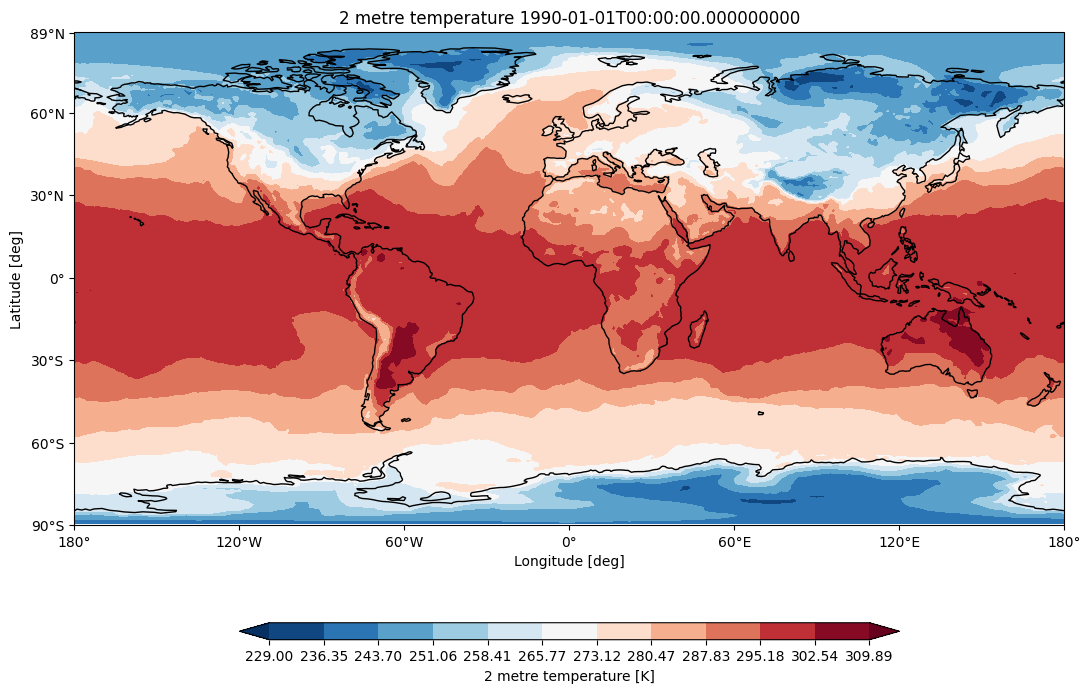
We used the regrid method to interpolate the data to a 1°x1° grid, with preprocessing of the weights already done
while initializating the Reader.
We then used the plot_single_map() function to plot the first timestep of the data.
This function has been used as accessor but can also be called as a standalone function.
See Accessors for more information.
We can now calculate the mean global temperature time series on the original grid. We will then go back to use the original data, without regridding them, to show area evaluation capabilities of AQUA.
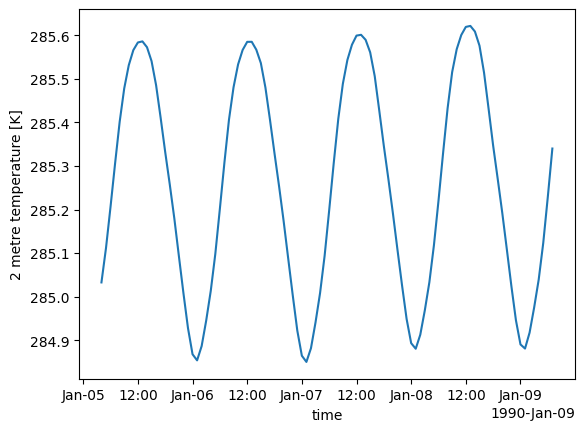
global_mean = reader.fldmean(data['2t'].isel(time=slice(100,200)))
global_mean.plot()
We obtain as image:
For more detailed examples and tutorials, refer to the Examples and Tutorials section of this documentation or explore the Jupyter notebooks provided with AQUA.