SSH variability
Description
The sshVariability diagnostic is a part of AQUA framework’s frontier diagnostic. It calculates the sea surface height (SSH) standard deviation for models (e.g. FESOM, ICON, NEMO)
and compares them against the AVISO model. This diagnotic can work on Healpix and standard Lat-Lon grid data. It also provides visualization of the SSH variability for the models.
SSH variability provides insights into the complex dynamics of the ocean.
It represents the changes in sea surface height over time, which can be influenced by various factors such as ocean currents,
wind patterns, tides, and interactions with the atmosphere.
By studying SSH variability, we can gain a better understanding of oceanic processes and their impact on climate.
High-resolution climate models simulate fine-scale variations in SSH, capturing small-scale features and regional differences
highly relevant in the context of climate adaptation for instance, coastal management such as managing coastal hazards like
flooding or storm surges.
Classes
There are two main classes in this diagnotic namely, sshVariabilityCompute and sshVariabilityPlot.
sshVariabilityCompute: class to compute the ssh variability. It retrieves the data on it original grid with an option of regridding the data on a different resolution. Then the ssh standard deviation (point-wise) is computed along the given time interval. If on time interval is provided, standard deviation will be perfromed over the whole domain. Then the data is stored in a netcdf file using the
AQUAOutputSaverclass.sshVariabilityPlot: class to plot the sshVariability. Once the standard deviation is performed, it can be passed to this class for plotting. This class plots the standard deviation for the given model and the reference AVISO data. It can also plot the difference between AVISO and the model standard deviation. This class also provides a functionality to plot selected region and the difference plots of the region. The user may as well choose the resoution on which they would like to plot the data.
BaseMixin: this class is called inside the sshVariabilityCompute class. This class basically retrieves the data using the
Readerclass in AQUA core and provides the functionality to save the output as netcdf file.PlotBaseMixin: this class is called inside the sshVariabilityPlot class. It mainly provides the functionality to save the plots as
PNGandPDF.
File Structure
The diagnostic is located in
src/aqua_diagnostics/sshVariabilitydirectory, which contains both the source code and the command line interface (CLI) script.The configuration file for the CLI is located in
config/diagnostics/sshVariabilitydirectory with default options.A notebook is avaliable in the
notebooks/diagnostics/sshVariability/sshVariability.ipynbdirectory with an example for using this diagnostic.README.md: a readme file which contains technical information on how to install the SSH diagnostic and its environment and, the version of the diagnostic.
Input variables and datasets
By default, the diagnostic compares against the AVISO dataset but can be configured to use any other dataset as a reference.
zos or avg_zos is the variable which is used in this diagnostic. The output (netcdf, PNG and PDF) is stored using the OutputSaver class in both BaseMixin and PlotBaseMixin classes.
The diagnostic is designed to work with both the data from the Low Resolution Archive (LRA) and the original high resolution Healpix data. The LRA is generated by the Data reduction OPerator (DROP) of the AQUA project, which provides monthly data at a 1x1 degree resolution.
Basic Usage
The basic usage of this diagnostic is explained with a working example in the notebook provided in the notebooks/diagnostics/sshVariability directory.
The basic structure of the analysis is the following:
Example usage
from aqua.diagnostics import sshVariabilityCompute, sshVariabilityPlot

# You can name these dictionaries as you like
dataset_dict = {
    "catalog": "climatedt-phase1",
    "model": "IFS-NEMO",
    "exp": "historical-1990",
    "source": "ssh-IFS-NEMO-test",
    "regrid": "r025",
}

dataset_dict_ref = {
    "catalog": "obs",
    "model": "AVISO",
    "exp": "ssh-L4",
    "source": "ssh-AVISO-test",
    "regrid": "r025",
}

startdate = "1994-01-01"
enddate = "1994-01-04"

# Initialize the SSH compute class
ssh_dataset = sshVariabilityCompute(
    **dataset_dict,
    var="zos",
    startdate=startdate,
    enddate=enddate,
)

# Run the compute function and save as NetCDF
ssh_dataset.run()

# Initialize the SSH compute class for reference data (AVISO)
ssh_dataset_ref = sshVariabilityCompute(
    **dataset_dict_ref,
    var="zos",
    startdate=startdate,
    enddate=enddate,
)

# Run the compute function and save as NetCDF
ssh_dataset_ref.run()

# Initialize the SSH plot class
plot_class = sshVariabilityPlot()

# Plot SSH for model dataset
plot_dataset = {"catalog": "climatedt-phase1", "model": "IFS-NEMO", "exp": "historical-1990"}
plot_class.plot(
    dataset_std=ssh_dataset.data_std,
    **plot_dataset,
    startdate=startdate,
    enddate=enddate,
)

# Plot SSH for reference dataset
plot_dataset_ref = {"catalog": "obs", "model": "AVISO", "exp": "ssh-L4"}
plot_class.plot(
    dataset_std=ssh_dataset_ref.data_std,
    **plot_dataset_ref,
    startdate=startdate,
    enddate=enddate,
)

# Plot the diference of sub region for model dataset and reference dataset AVISO
time_intervals = {
    "startdate": "1994-01-01",
    "enddate": "1994-01-04",
    "startdate_ref": "1994-01-01",
    "enddate_ref": "1994-01-04",
}

region_selection = {
    "region": "Agulhas",
    "lon_limits": [5, 50],
    "lat_limits": [-10, -50],
    "proj": "plate_carree",
    "proj_params": {},
    "tgt_grid_name": "r3600x1800"
}

_dataset_ref = {
    "catalog_ref": "obs",
    "model_ref": "AVISO",
    "exp_ref":"ssh-L4",
}

_dataset = {
    "catalog": "climatedt-phase1",
    "model": "IFS-NEMO",
    "exp":"historical-1990",
}

plot_class.plot_diff(
    dataset_std=ssh_dataset.data_std,
    dataset_std_ref=ssh_dataset_ref.data_std,
    **_dataset,
    **_dataset_ref,
    **region_selection,
    **time_intervals
)
Note
The user can also define the start and end date of the analysis and the reference dataset. If not specified otherwise, plots will be saved in PNG and PDF format in the current working directory.
CLI usage
The diagnostic can be run from the command line interface (CLI) by running the following command:
cd $AQUA/src/aqua_diagnostics/sshVariability
python cli_sshVariability.py --config_file <path_to_config_file>
Additionally, the CLI can be run with the following optional arguments:
--config,-c: Path to the configuration file.--nworkers,-n: Number of workers to use for parallel processing.--cluster: Cluster to use for parallel processing. By default a local cluster is used.--loglevel,-l: Logging level. Default isWARNING.--catalog: Catalog to use for the analysis. Can be defined in the config file.--model: Model to analyse. Can be defined in the config file.--exp: Experiment to analyse. Can be defined in the config file.--source: Source to analyse. Can be defined in the config file.--outputdir: Output directory for the plots.
Config file structure
The configuration file is a YAML file that contains the details on the dataset to analyse or use as reference, the output directory and the diagnostic settings. Most of the settings are common to all the diagnostics (see Diagnostics configuration files). Here we describe only the specific settings for the sshVariability diagnostic.
sshVariability: a block (nested in thediagnosticsblock) containing options for the SSH Variability diagnostic. Variable-specific parameters override the defaults.run: enable/disable the diagnostic.diagnostic_name: name of the diagnostic.sshVariabilityby default.variables: list of variables to analyse. InsshVariabilitythis variable iszosoravg_zos.startdate_data/enddate_data: time range for the dataset.startdate_ref/enddate_ref: time range for the reference dataset.
plot_params: defines colorbar palette and limits and projection parameters. The default parameters are used if not specified. Refer to ‘src/aqua/util/projections.py’ for available projections. Note that the plots can be stored on the original resolution or the data can be regridded to another resolution for a quick plot. The default for plotting regrid variabletgt_grid_name: 'r360x180'with the regridding methodregrid_method: 'ycon'. More options for regridding are documented on the topic of Regridding in AQUA <https://aqua.readthedocs.io/en/latest/regrid.html>_
Output
The diagnostic produces four types of plots:
Global SSH variability plots for the given model and the reference.
Global difference plot (model vs reference)
Regional SSH variability plots for the given model and the reference.
Regional difference plot (model vs reference)
Plots are saved in both PDF and PNG format.
Observations
The default reference dataset is from AVISO Sea Surface Height Data, but custom references can be configured.
References
Copernicus Climate Change Service, Climate Data Store, (2018): Sea level gridded data from satellite observations for the global ocean from 1993 to present. Copernicus Climate Change Service (C3S) Climate Data Store (CDS). DOI: 10.24381/cds.4c328c78 (Accessed on 01-Mar-2023)
Example Plot(s)
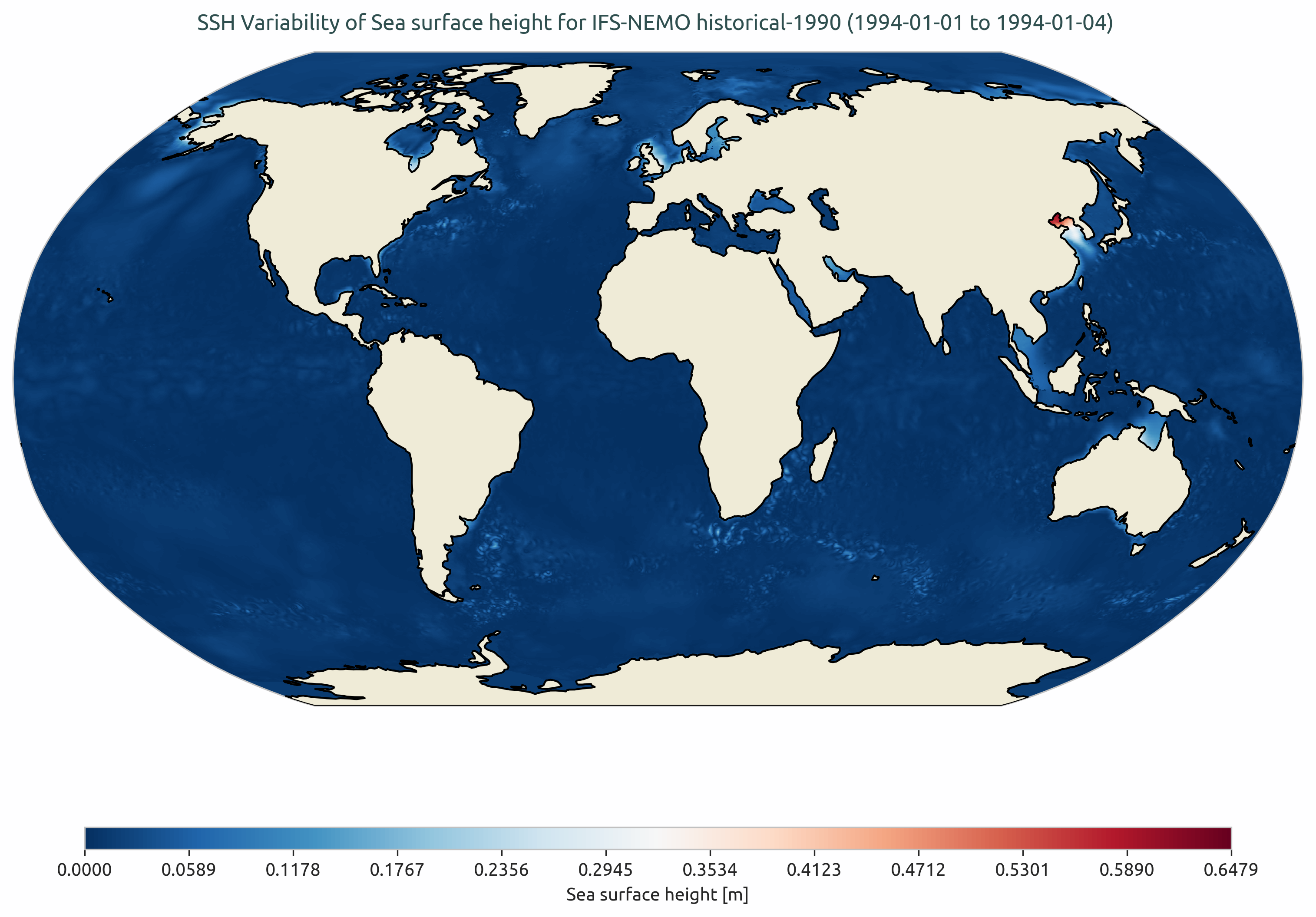
SSH Variability for IFS-NEMO historical-1990.
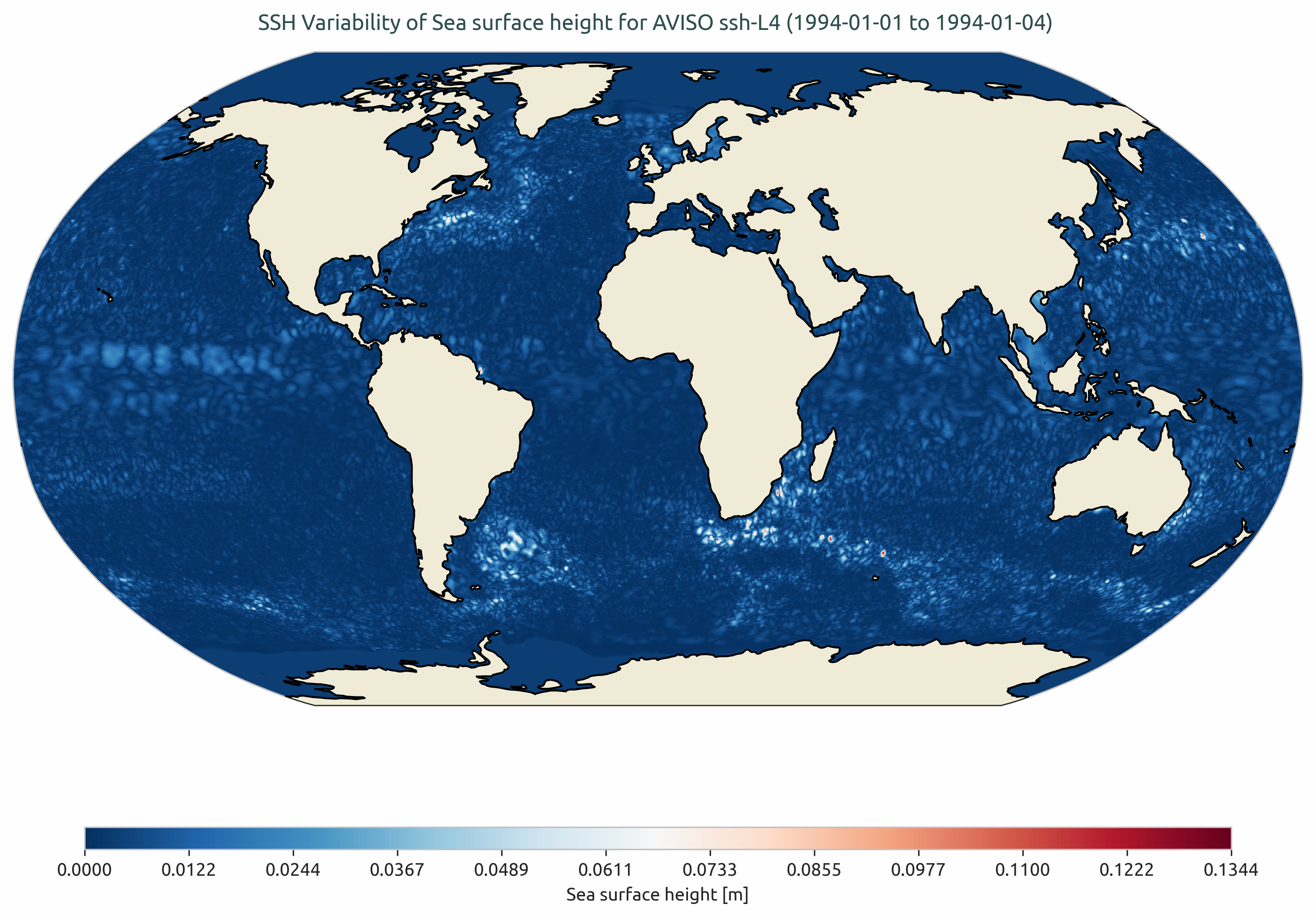
SSH Variability for AVISO data.
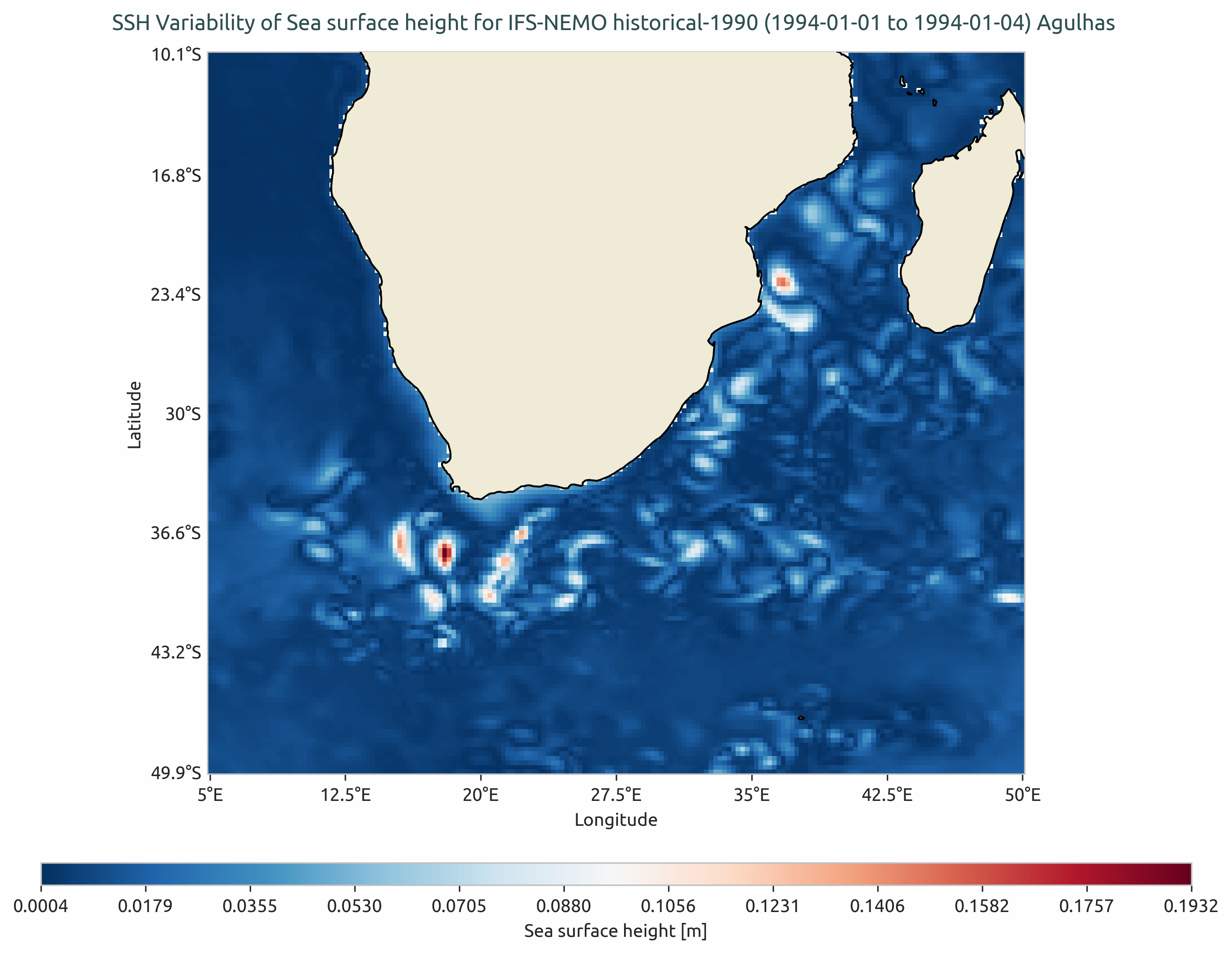
SSH Variability for IFS-NEMO in Agulhas region.
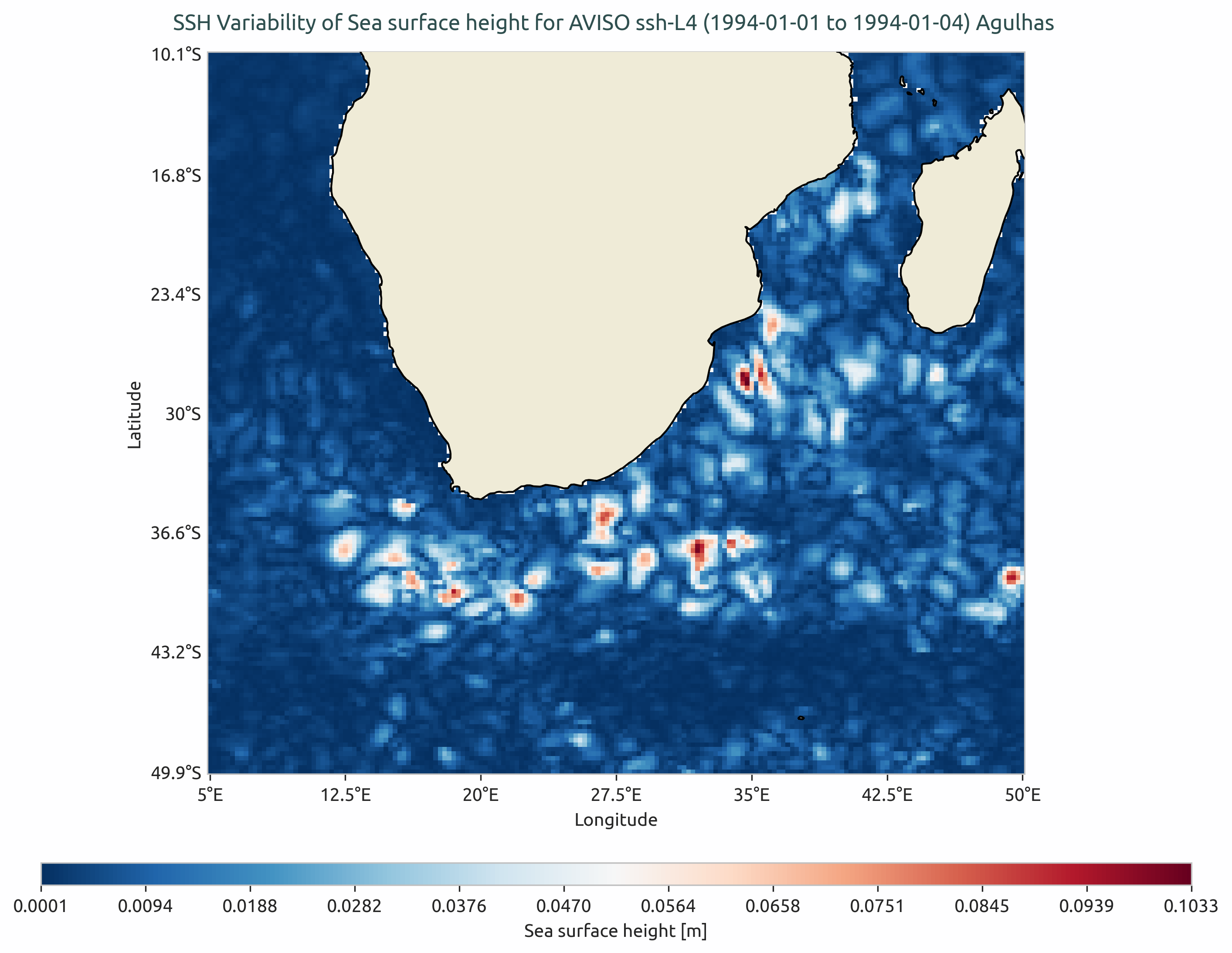
SSH Variability for AVISO in Agulhas region.
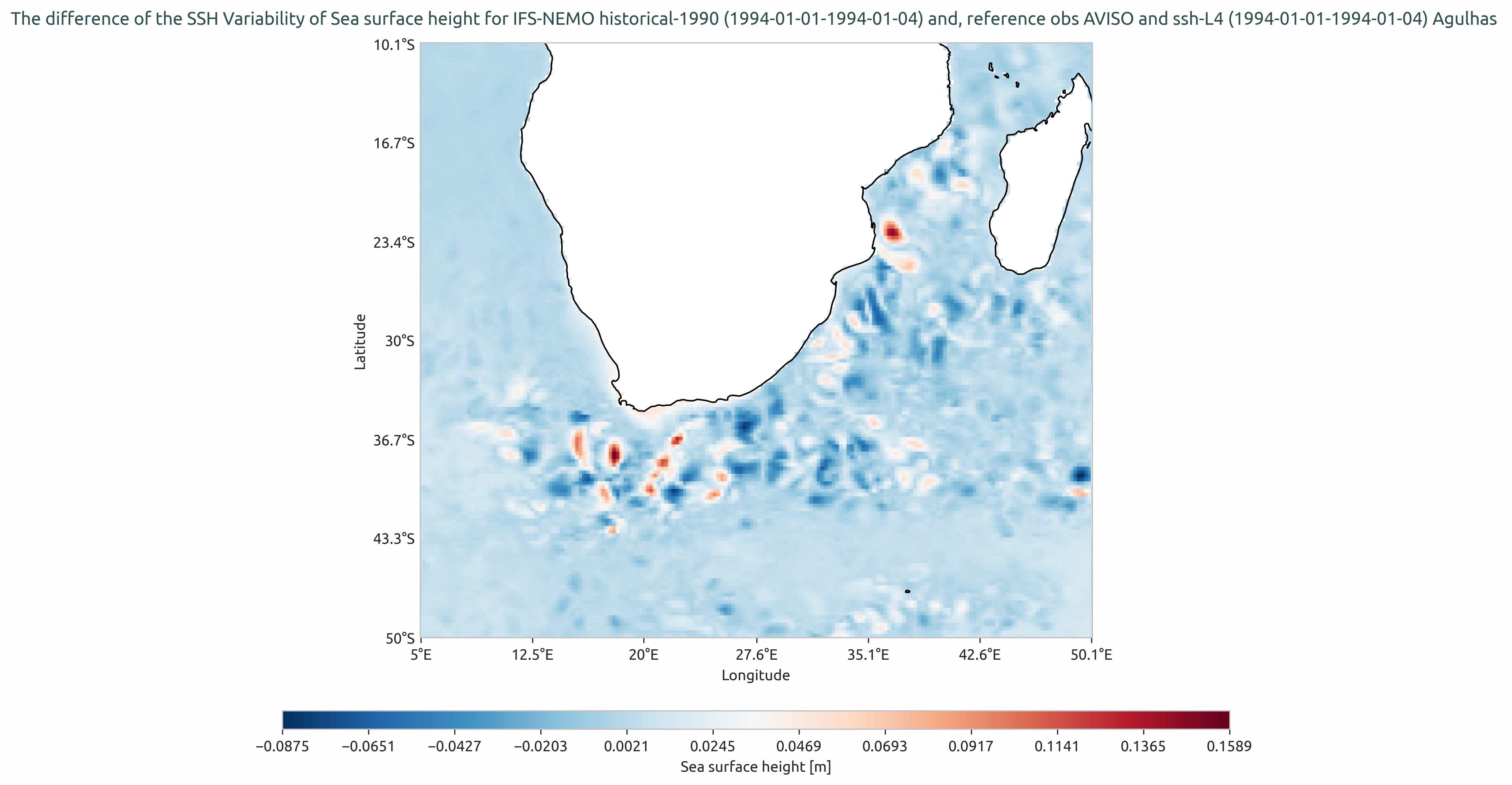
SSH Variability difference between IFS-NEMO and AVISO in Agulhas region.
Available demo notebooks
Notebooks are stored in the notebooks/diagnostics/sshVariability directory and contain usage examples.
Detailed API
This section provides a detailed reference for the Application Programming Interface (API) of the sshVariability diagnostic,
produced from the diagnostic function docstrings.